

Posts tagged pagasa philippines
PH among top countries in microfinance, says study
The Philippines remains a global leader in microfinance, with an international report placing the country among the top five in overall microfinance business environment rankings.
The country ranked 4th out of 55 in the Economist Intelligence Unit’s “Global Microscope on the Microfinance Business Environment 2012,” jumping two places from ranking 6th last year.
This, as it highlighted significant changes which are seen to promote the development of an enabling microfinance environment.
These include central bank Circular No. 744, which redefined microfinance loans to include amounts up to P300,000 from the previous P150,000.
Also noted was the House approval of a draft law which allow foreign ownership of up to 40 percent in rural banks.
The country’s score improved by 4.8 points to 63.3 index points calculated based on its performance in regulatory framework and supporting institutional framework.
The Philippines was one of only three Asia countries in the top 10 of the report, which covers a year’s period to June 2012.
This year’s overall ranking was topped by Peru, Bolivia and Pakistan. Below the Philippines, meanwhile, were Kenya, El Salvador, Colombia, Cambodia, Mexico and Panama.
In terms of regulatory framework, the Philippines shared the top spot with Peru, scoring 80 points.
“The Bangko Sentral ng Pilipinas (BSP, the central bank) continues to promote an enabling environment for microfinance, seeing it as one of its key poverty reduction efforts,” the report said.
A number of public sector institutions meanwhile provide wholesale funds to support the sector’s growth, it added.
Although improving by five points, the Philippines posted a slightly weaker performance, scoring 50 and sharing the 15th place with Brazil, Nicaragua and Uruguay.
“The industry remains relatively fragmented, as there is no one dominant institutional type, set of institutions, or network and multiple regulatory and supervision regimes owing to the diversity of the types of service providers,” the report said.
The country’s weak showing in this indicator may also attributed to a low “stability” score, particularly in terms of “political stability.”
http://ph.news.yahoo.com/ph-
ADB: Poor Pinoys have little access to microfinance
by Cai Ordinario
Posted on 10/17/2012 11:30 AM | Updated 10/17/2012 1:51 PM
MANILA, Philippines – Only 3 million poor Filipinos or those living under $1.25 per day had access to microfinance loans in the Philippines in 2010, according to a study released by the Asian Development Bank (ADB) on Tuesday, October 17.
In a report titled Microfinance Development Strategy 2000: Sector Performance and Client Welfare, the ADB’s Independent Evaluation Department said this means that the penetration rate of microfinance loans among the poor was only at 14%.
Measured against a total population of 94.1 million in the Philippines, this means microfinance loans only reached 3.2% of Filipinos.
The ADB said while this already showed an improvement in microfinance penetration in the country, the microfinance penetration rate among the poor was significantly lower than Vietnam’s and Cambodia’s 75% and 32%, respectively.
According to the study, microfinance loans in Vietnam covered 8.5 million or 9.8% of its total population of 86.5 million as of 2010. In Cambodia, the ADB said there were 1.3 million covered by these loans or 9.1% of its total population of 14.3 million.
Penetration rates compare active borrowers against a potential client base of the population living below the international poverty line of $1.25 per day, the ADB said. Despite the growth in outreach and microfinance providers in Cambodia and Philippines, penetration rates were only 32% and 14%, respectively.
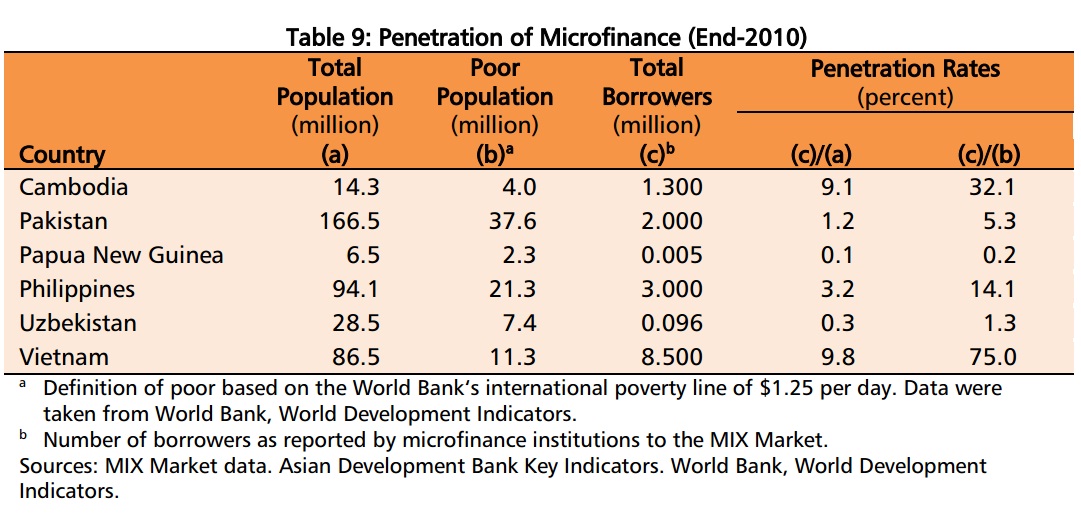
POOR ACCESS. The table shows how many poor people have access to microfinance in 6 countries. The image was obtained from the report.
Microfinance loans aplenty
The low penetration rate of microfinance loans in the country contrary to their availability. The study stated that the Philippines actually had a total of 14,935 microfinance providers, higher than in most countries. This was largely due to the high number of cooperatives that offer microfinance loans.
Further, the ADB said the Philippines was the second-largest recipient among 6 countries that received microfinance assistance from the ADB, accounting for a share of 19%.
Funds extended to the Philippines by ADB reached $173 million, of which $150 million was a sector development program loan approved in 2005.
During the 2000 to 2010 period, ADB support to 6 countries, including the Philippines, amounted to $916 million or nearly 33% of ADB’s total microfinance portfolio.
Program and sector development loans comprised the largest amount among the modalities of assistance at $660 million, while grants and Technical Assistance operations were the smallest at $18 million.
Microfinance has been mainstreamed in the banking sector and is supervised by the central bank. In the Economist Intelligence Unit 2011, of 55 surveyed countries globally, Pakistan and Philippines both ranked first and Cambodia third in the category of regulatory framework and practices, and they were 5th, 17th, and 25th, respectively, in terms of the supporting institutional framework. This suggests strong regulatory regimes and good prospects for microfinance in these countries, the ADB said.
Regional trend
In a statement, ADB said the penetration of microfinance among the poor in Asia and the Pacific remains low. As of the end of 2010, only 20% of the population living below the poverty level of $1.25 per day had direct access to microfinance services in 21 developing countries receiving ADB microfinance support. This level was below ADB’s goal.
Microfinance is seen in the region as an important means to helping low-income households take advantage of economic opportunities and improve living standards.
Despite the increasing popularity of microfinance in recent years, expanding the access of poor households to institutional financial services remains a great challenge to governments and development agencies, ADB’s Director General of Independent Evaluation, Vinod Thomas said in a statement.
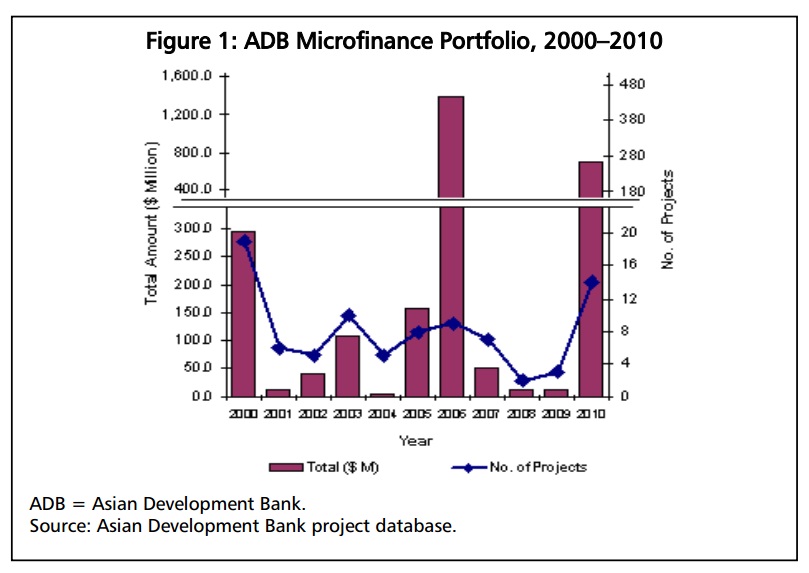
MICROFINANCE LOANS. The chart shows the performance of ADB’s microfinance lending between 2000 and 2010. The image was obtained from the report.
The study said that for microfinance to have a greater impact on reducing poverty in the region, it needs to better target the poor and focus more on educating them in using basic financial services. Effective linking of microfinance services to complementary pro-poor interventions is also urged.
ADB said around 2.7 billion people worldwide or 70% of the adult population in the world’s developing countries, have no access to formal financial services, such as savings or checking accounts. They represent a key and still largely untapped market segment for financial inclusion. Rappler.com
source: http://www.rappler.com/business/14331-only-3-m-poor-pinoys-have-access-to-microfinance-adb
Angelita Abesamis Story – San Mateo Rizal Branch
SUCCESS THROUGH SMOKE-FISH VENDING AND WITH THE HELP AND SUPPORT OF PAGASA PHILIPPINES: By Vencent A. Abraham, Deputy Director
Angelita Abesamis Story :San Mateo Rizal Branch PAGASA Philippines
ASA Philippines Success Story
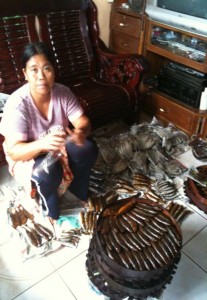
To earn money and make profit in business requires huge dedication, discipline and determination to succeed in business and in life as Mrs. Angelita Abesamis claim. Mrs. Abesamis a mother of three (3) kids 19, 10 and 9 years old. She married with Rogelio Batungbakal.
Mrs. Abesamis and her husband starts with a very small capitalization in business and they are engage into selling smoke fish in their area, one of the reason which motivate the family to ventures into business is family survival which will able them to support their daily family needs. But over the years of into business and dedication they are amaze that out of their business they were able to send their children to school, invest some home appliances and able to build their own house.
Currently, she is an active borrower of PAGASA Philippines in San Mateo Rizal branch and she is now into 5th loan cycle with loan of Ph 25,000.00 (245 USD), she is currently belong to Winnie the Pooh group availing our Small Business Loan product.
Mrs. Abesamis claimed that prior to her membership in PAGASA Philippines, she gets additional capitalization and loan from loan sharks (5-6) and Bombay’s (Indian lenders) with a very high interest rates. And when one of his customers introduces PAGASA Philippines to her she was interested since she was able to get some information with regards to the company and because of her interest she attended the group meeting to gained more information. When she was oriented with the company loan methodology and policies she was interested and awaken because PAGASA Philippines offers a very low interest rates as compare to loan sharks, Indian lenders and even other microfinance and aside from it the company’s simple loan system and procedures without any hesitation she availed the 1st loan last August 12, 2009 amounting to Ph 5,000.00 ( 111 USD) and the succeeding loan and gradually improve its business.
After more than a year of being borrower in PAGASA Philippines Angelita Abesamis observes that there are transformation in their family particularly because of the loan from the company they were able to pay their monthly amortization of their motorcycle used for smoke fish delivery, diversify into new business which is junk shop and send kids in private school. I am so thankful with Pagasa Philippines and I am forever grateful to the company because of their genuine heart to help us Mrs Abesamis said.
The family earn income out of selling smoke fish in the area and nearby town but because of their capitalization increase out of the loan from PAGASA Philippines they were now able to sell and distribute their product to other cities of Metro Manila through their more than twenty (20) vendors and even Mrs. Abesamis also sell their product house to house, she is not just totally dependent with its vendors. The family bough fish and process the fish through smoke machine but this is being sub-contract because the family don’t have available machine to process its product. That’s why in the future they intend to have their own machine to process their own product and dependent on the sub-contractor but this requires big capitalization. But she is determine it will happen in the future through the help of the company.
Mrs. Abesamis intend to stay in the program since she was able to realize that the loan policies and procedure of the company is indeed a pro-borrowers through its low interest rates, individual accountability, and very simple processes and don’t have plan to transfer to other microfinance institution or to loan again with loan sharks or Indian lenders. I am totally satisfied with the service of PAGASA Philippines it is really a certified global company but with the heart for the poor, I will be more successful in the future through smoke-fish vending and through the help and support of global company which is PAGASA Philippines she explained.
I am excited to avail the monthly repayment system because I know that it will be more advantageous and helpful to us, I have learned the new system to other group who are now into monthly repayment system hopefully we can be immediately included in the new system..she shared.
Through the family good values, positive attitude in life and their ability to sell processed and smoke fish they were determine to be out from the bondage of poverty and to become successful micro-entrepreneur that will also create impact in their community through helping other people.
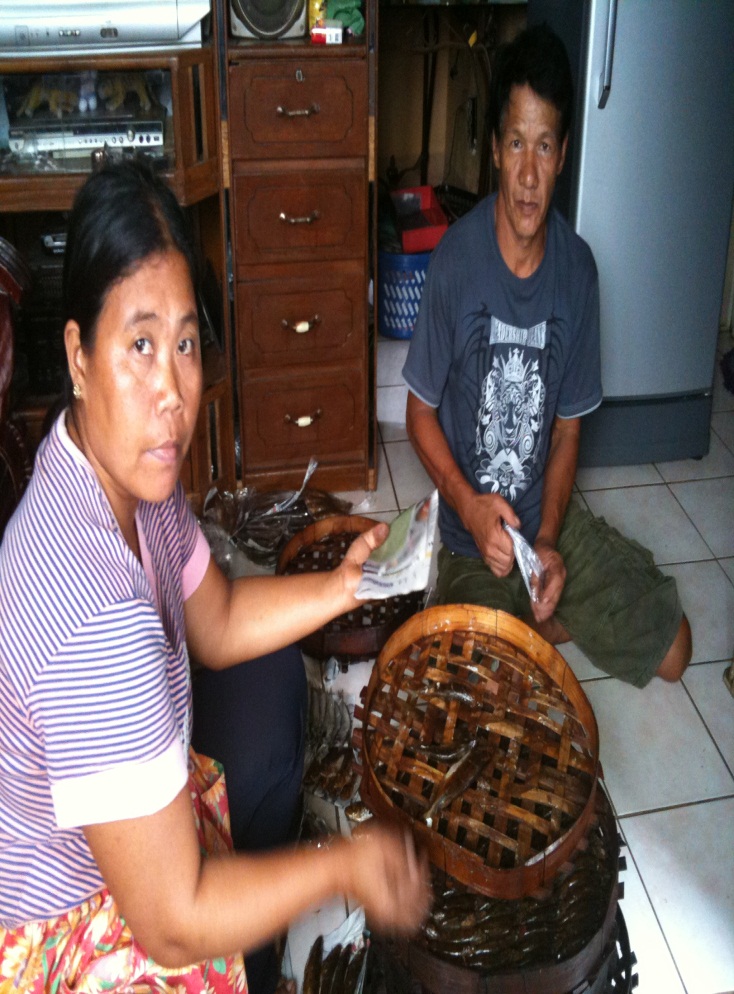
A Gemma Toledo Success Story – San Mateo Rizal Branch
GARMENTS TO SUCCEED through PAGASA Philippines: by Vencent A. Abraham, Deputy Director
A Gemma Toledo Success Story San Mateo Rizal Branch
ASA Philippines Success Story
OPPORTUNITY IN WORK RETRENCHMENT Gemma Toledo is working as quality supervisor in one of the jeans and shirt manufacturing in the Philippines for a couple of years. Her husband also works with her in the same company as sewer and garments cutter. However, due to economic crisis their company where they work was affected and that time hundred and thousands of employees was cut or retrench from work.
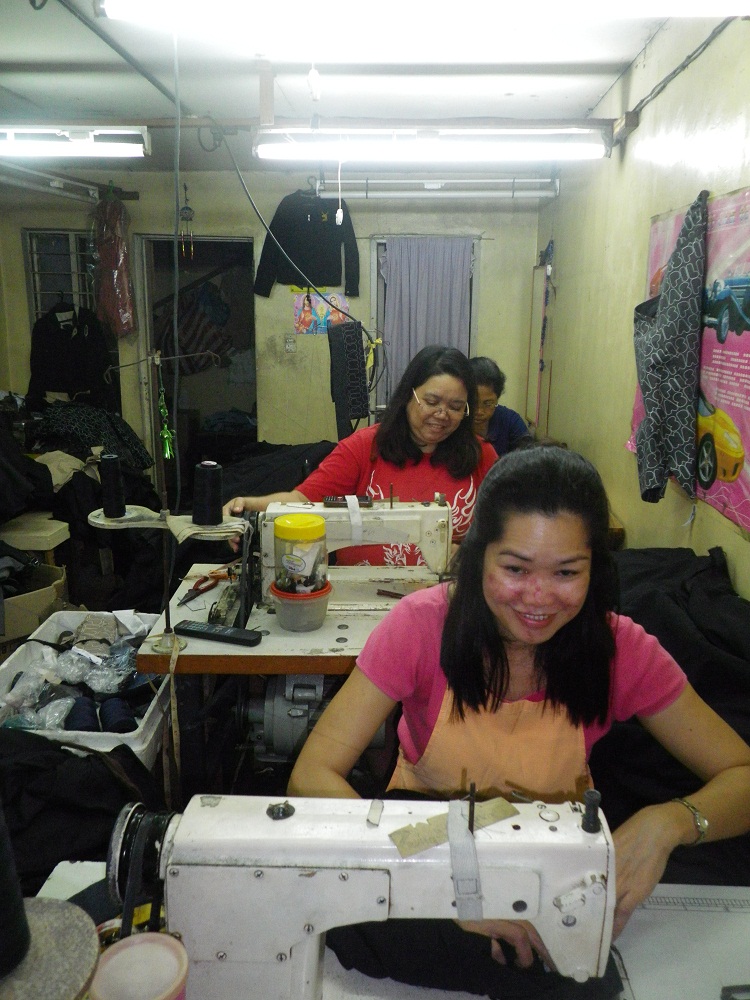 Due to family responsibility to deliver and provide the needs of their children they have to earn income for a living. On the onset both husband and wife think deeply as to what to do and how they will move after work retrenchment to respond to their family needs either to work again or to engage to business. Their major consideration is their age and almost of the company will not accept them because they are already over age. Then, after considering all of the factors they have decided to engage into a small business and they have capitalized on their experience in garments industry. We have think million times as to what business to start but when both of us agree to engage into garments business, we are determine to succeed no matter what. Gemma Toledo statement.
In 2007 four years ago Gemma Toledo established her own garment business where they accept sub-contract from local branded clothes for cutting and sewing of garments. At the start she experienced difficulties in getting contract from big company but because of his networks and contact in the garments industry she was able to get some small contract for a start. I learn to negotiate, and deal with prospective customers and enter into contract to survive in the business she claims. And she start the business with four machine and she work in tandem with her husband and they have used their money which they received from their previous company as initial capitalization in the business.
One time when she was in need of money for additional capitalization because received a bulk contracts from different company she approached her neighbor to borrow money but her neighbor introduced to her the program of PAGASA Philippines in 2010. She was afraid to enter into formal lending since she don’t have any experienced to lend from formal lending company, loan sharks or Indian lenders. But she was encouraged by her group leader since she have a small home-based business. Then on July 30, 2010 she received her 1st loan in PAGASA Philippines amounting to Ph 7,000.00 (155 USD) and paid the loan amortization on a weekly basis. That time Gemma Toleda appreciated the service of the company for its fast release service, less documentation requirements and simple loan procedure. The money she received from the company was infused as additional capital in the business and she roll-it over to gain income.
After paying the entire loan amortization for the 1st loan cycle, she again availed the re-loan but with the new loan repayment system which is monthly repayment system. She really like the new loan repayment system I like the new system because I can fully use my money to gain even more income before I will pay the company, the new system is more beneficial to borrower like me, Gemma Toledo emphasize. Because of her loan received from the company she was able to buy additional cutting machine for garments.
Mrs. Gemma Toledo decided to stay in the company since this is the first company which she gave her trust to be of partner for growth and business success and in the coming years she plan to increase and expand her business through buying more machine for her garments business, machine like piping machine and four thread machine for t-shirt to get more contract and gain more income.
I am determined to succeed in the garments industry and I am confident that PAGASA Philippines will help me all the way Gemma Toledo declares.