


The total population of the Philippines as of May 1, 2010 is 92,337,852 based on the 2010 Census of Population and Housing with an estimate of 94 million in 2012. The first quarter of 2012 based on Social Weather Survey (SWS), fielded over May 10-13, 2012 found that 55% (estimated 11.1 Million) families consider themselves as Mahirap or Poor, 10 points higher than the 45% (estimated 9.1 Million in December 2011 (Chart 1). These are the Filipinos who are living on a less than US$2 a day. It is also found out that 45% (est. 9.1 Million consider themselves as Food-Poor, 9 points up from 36% (estimated 7.2 Million in the previous quarter (Chart 2,). The actual poverty situation is worse. Compared to the previous quarter it hardly changed in Metro Manila and the rest of Luzon, however, it rose sharply by 34 points in Mindanao, from 38% to 72%, the highest in over eight years, since 77% in November 2003. It also rose in the Visayas, up by 9 points from 52% in the previous quarter to 61% now. It barely changed in urban areas, from 41% to 40%, but rose 17 points in rural areas from 49% to 66. This state is not expected to significantly change.
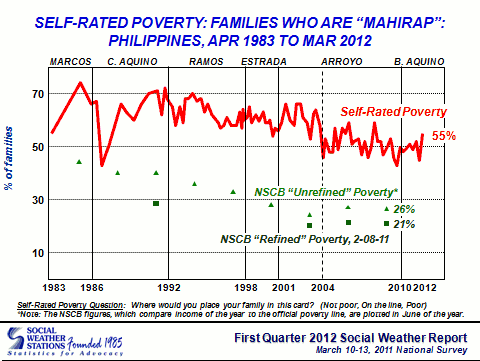
Chart 1
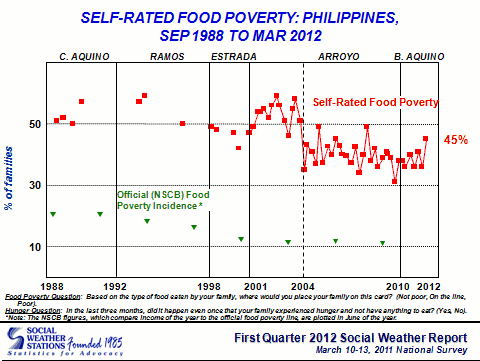
Chart 2
The Philippine Economic Situation
The Philippine economy does not face healthy prospects. It has been hit largely by negative external developments, including the European debt and economic woes, the weak recovery of the U.S. economy and the supply chain disruptions due to the flooding in Thailand. The Filipino public has a negative sentiment about the trend.
In addition, the country was hit by numerous typhoons that resulted in heavy damages, among others, to the country’s agriculture and infrastructure sectors. NEDA estimates that the total damages caused by typhoons Pedring, Quiel and Sendong alone represent about 1.54 percent of the fourth quarter GDP.
However, notwithstanding the negative shocks to the economy, bright spots remained. Filipino people refuse to give up. Department of trade and Industry (DTI) data suggests that the microentrepreneur segment of society has been growing steadily since the beginning of 1990s. While there was a general economic slowdown during the Asian crisis in the last decade, the microenterprise segment has since then recovered. Each microenterprise is bound to need small loans from Microfinance operators during the course of the business cycle.
The National Strategy for Microfinance
The current aggressive government support for the Microfinance industry is timely and appropriate. Prepared by the National credit Council, the National Strategy for Microfinance aims to provide access to financial services to the majority of the poor households and microenterprises which started in 2005. It has liberalized the private sector to contribute and plays a major role in enabling the environment for the efficient functioning of markets. With government support in terms of concessional funds and capacity building services, this is definitely the best time to be in the business. For the 5 million poor needing credits for microenterprises, access to microcredit/finance and markets will be part of the solution by creating jobs for themselves and work for others. (Paradox of growth by Lila Ramos Shahani, an assistant secretary of the National Anti-poverty Commission)